
Investing Globally, Making Use of Swiss Tax Advantages: How Your Equity Portfolio Should Be Structured Today
Before we receive income from social insurance and pension schemes—for example, upon retirement—the equity portfolio of a person domiciled in Switzerland should make deliberate use of the advantage of tax-free private capital gains. This does not mean that the capital itself is entirely tax-free: gains realised when selling securities held as private assets are generally tax-free. This advantage also applies after retirement.
This leads to a useful principle: when building wealth over the long term, what matters is the total return after taxes and costs. A portfolio therefore does not need to pay the highest possible dividends. Cash requirements can also be met by selling small portions of the portfolio.
The distinction is significant: dividends are generally subject to income tax. An accumulating ETF, which automatically reinvests its income, does not make that income tax-free either. Tax treatment distinguishes between investment income and capital gains. In addition, cantonal and municipal wealth taxes apply to taxable net assets.
The exemption for private capital gains also depends on the investor not being classified as a professional securities trader. This distinction deserves particular attention when realised gains finance a substantial share of living expenses. Circular No. 36 of the Swiss Federal Tax Administration sets out criteria for a preliminary assessment.
Tax considerations alone, however, do not justify concentrating on individual growth stocks. A lower dividend is neither a sign of quality nor a guarantee of higher capital gains.
A Global Core Instead of a Bet on Individual Winners
A well-diversified equity portfolio spreads capital across countries, sectors and companies. Investors who hold only Swiss shares remain dependent on the composition of a small domestic market, even when those companies operate internationally. Investors who buy only technology stocks concentrate their exposure on similar economic drivers.
A broadly diversified, low-cost global equity fund therefore provides a useful starting point. An index such as the MSCI ACWI includes large and medium-sized companies from developed and emerging markets, covering approximately 85% of the global investable equity market.
An Example:
An initial investment of CHF 200,000 would have grown to approximately to an ending value of CHF 537,400 over the ten-year period, generating an investment gain of around CHF 337,400. This represents a cumulative return of approximately 168.7%, equivalent to an annualised return of 10.39%.
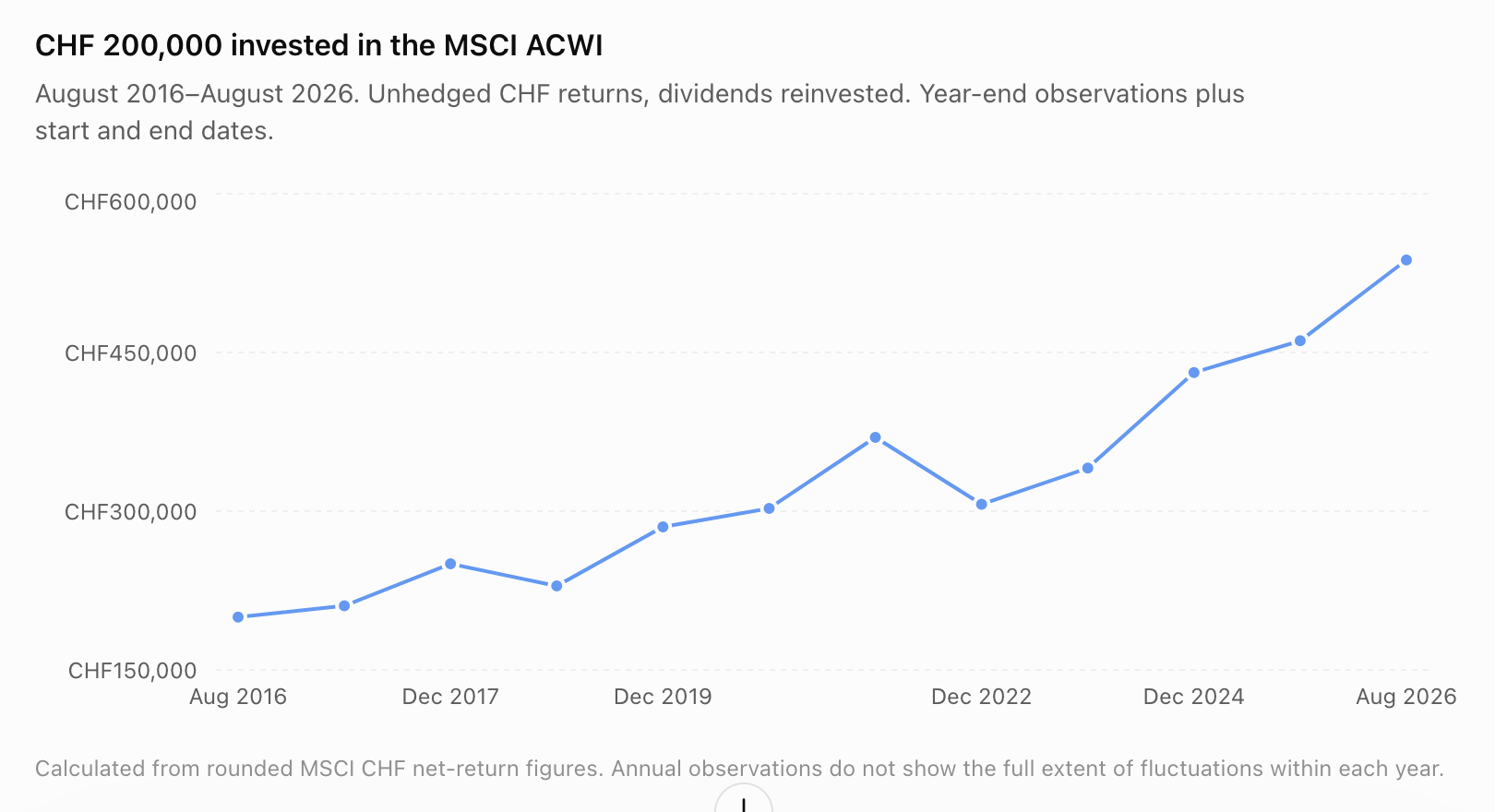
A single broadly diversified ETF can already provide exposure to many companies, regions and sectors. More funds do not automatically mean more diversification: if several ETFs hold largely the same stocks, they mainly add complexity.
Selection criteria include the breadth of the index, ongoing fees, trading costs, tax reporting transparency and withholding-tax implications. A listing in Swiss francs does not eliminate the currency risk of the underlying foreign investments.
Why Diversification Significantly Reduces Risk And Where Is It’s Limitation
Diversification works because companies do not perform identically. One company’s product launch may fail while another gains market share. A single bankruptcy has a much smaller impact on a broadly diversified portfolio than on a portfolio containing only a few holdings.
However, many stocks respond together to recessions, higher interest rates or global crises. This shared risk remains. We can calculate the mathematical limit using a simplified model.
In this model, diversification can halve volatility from 30% to 15%. Variance—the square of volatility—falls by 75%. With 20 stocks, 95% of the theoretically possible variance reduction has already been achieved.
This does not mean that any collection of 20 stocks is sufficiently diversified. Their weights and shared risks are crucial. Twenty similar companies may be much more strongly correlated than a broad selection of global investments. The 15% limit is also neither a universal figure nor a maximum possible loss. If the assumed correlation rises to 0.50, the theoretical minimum volatility increases to.
Diversification therefore primarily reduces company-specific risk. It does not prevent large losses across the equity market.
Retirement Also Requires a Withdrawal Plan
The appropriate equity share of total wealth depends on when the money will be needed and which expenses are covered by pensions or other reliable income.
After retirement, funding CHF 100,000 in annual living expenses entirely from your portfolio would require assets of approximately CHF 2 million, assuming an annual return of 5% after tax and costs. If pension payments cover part of these expenses, the portfolio only needs to finance the remaining gap.
Anyone who needs to finance several years of living expenses from their assets before pension payments begin should account for that expected funding gap separately. A reserve in Swiss francs—for example, in bank accounts or suitable short-term, high-quality CHF investments—can help avoid having to sell stocks after a sharp market decline to cover ongoing expenses.